
Introduction
Singapore’s colonial architecture is best explored in and around the Civic District on a Singapore tour. From historically significant landmarks to national museums, the are plenty of options to engage the curious traveller. Following Singapore’s founding as a British trading settlement in 1819, a of civic, commercial and recreational buildings began to populate the colonial port city — many of which still stand today.
Thanks to Singapore’s excellent connectivity, the Civic District is highly walkable. Travellers can explore it at a relaxed pace, travelling between key attractions and the Singapore River, while taking in views of the glittering Marina Bay skyline. It’s one of the few places in Asia where you can experience over a century of history in a single day — from early trading outpost to global financial hub.
Each landmark reflects the ambitions of empire, the realities of trade along the Singapore River, and the lives of sojourners, labourers and merchants who coexisted alongside local communities. For those looking for meaningful things to do in the Civic District, exploring these architectural landmarks offers one of the clearest introductions to Singapore’s history and culture.
For those planning a Singapore tour, the Civic District offers one of the most compelling introductions to the city’s colonial past.
Top Civic District Singapore Landmarks to Explore
Victoria Theatre and Concert Hall — Civic Grandeur by the Singapore River
Originally completed as the Victoria Memorial Hall in 1905, this landmark reflects the civic ambitions of colonial Singapore. Positioned along the Singapore River, it anchors the historic district where administration, culture and commerce once converged.
The design evolved through multiple hands — from initial plans by Major Alexander Murray to refinement by R. A. J. Bidwell of Swan & Maclaren. The result is a Palladian-style landmark that helped define the architectural character of the riverfront.
Former General Post Office (Fullerton Hotel) — Monument of Empire
Completed in 1928, the former General Post Office — now the Fullerton Hotel Singapore — symbolised Singapore’s role in the British Empire’s communication network. Its Doric columns project authority along the Singapore River.
The building’s sculptural detailing was executed by Italian sculptor Cavaliere Rudolfo Nolli, whose work appears across several of Singapore’s civic landmarks. At Fullerton, the lofty portico above the main entrance features classical trophy motifs and the royal coat of arms, reinforcing the building’s institutional significance.
Nolli also contributed to the former Supreme Court — today part of the National Gallery Singapore — where his work can be seen in the tympanum above the Former Supreme Court Balcony and the Corinthian columns. Collectively, these details reflect how European craftsmanship was embedded into Singapore’s colonial architecture, shaping the visual identity of its civic district.
Raffles Hotel — Colonial Luxury in the Tropics
Designed by Swan & Maclaren and completed in 1899, the iconic main building of Raffles Hotel Singapore represents a more relaxed, tropical form of colonial architecture. The hotel itself was founded by the Armenian Sarkies brothers, whose vision shaped it into one of Asia’s most iconic colonial-era hotels. Beyond its design, the hotel became a social hub for travellers and merchants, reflecting Singapore’s role as a crossroads of cultures and commerce.
Inspired by the lush grounds of Raffles Hotel Singapore, the Traveller’s Palm became an iconic fixture of the hotel and enduring symbol of hospitality and adventure. In the past, it was said that the Travellers’ Palm offered weary travellers both refreshment and direction — rainwater gathered in its leaves, while their east–west orientation provided a natural guide along the journey.
On a Civic District Singapore Tour, your local guide can conveniently drop you off at Raffles Hotel to partake in the travellers’ tradition – enjoy a Singapore Sling at the famous Long Bar.
Armenian Church — The First Christian Church in Singapore
Designed by George Drumgoole Coleman, the Armenian Church is widely regarded as his masterpiece. While grounded in Palladian symmetry, it incorporates tropical adaptations such as verandahs and ventilation louvres, reflecting an early response to Singapore’s climate.
Completed in 1835, the church stands as a testament to the Armenian community, whose growing presence in the early 19th century was closely tied to regional trade opportunities. Though small in number, Armenians played a significant role in Singapore’s development as lawyers, merchants and entrepreneurs. Notable figures include the Sarkies brothers, founders of Raffles Hotel Singapore, Agnes Joaquim, who hybridised the Vanda ‘Miss Joaquim’, and Catchick Moses. Today, the church remains a quiet tribute to this influential community and their legacy in Singapore’s history.
National Museum of Singapore — Cultural and Architectural Landmark
The National Museum of Singapore reflects Neo-Palladian design, defined by symmetry, proportion and classical restraint. Its façade conveys stability — a hallmark of colonial architecture in a rapidly developing port city.
A defining feature of the building is its prominent central dome, which crowns the original structure and anchors its architectural composition. Introduced as part of early 20th-century extensions, the dome not only enhances the building’s visual presence along Stamford Road but also reflects the colonial emphasis on monumentality and civic identity. Originally established as the Raffles Library and Museum, it served as a centre for knowledge and governance, housing important collections that documented the region’s natural and cultural history.
Today, the museum remains one of the most significant cultural institutions in the Civic District. Its galleries continue to evolve, and visitors can look forward to refreshed exhibitions — including updates to the Singapore History Gallery that is slated to reopen in October 2026. Please check the museum website for other current exhibitions.
National Gallery Singapore — A State-of-the-Art Visual Arts Museum
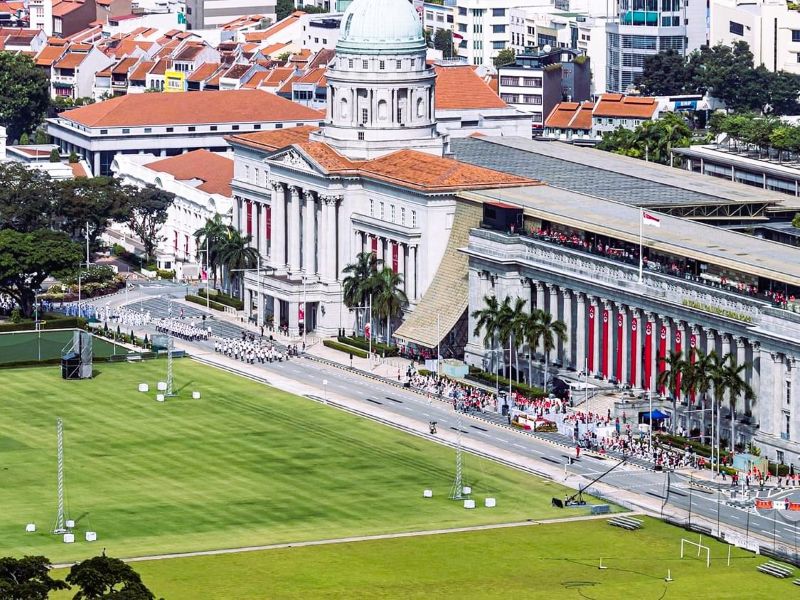
Housed within the former Supreme Court and City Hall, the National Gallery Singapore brings together two of Singapore’s most significant colonial-era buildings. Their architecture reflects the authority of British governance, from the grand neoclassical façades to the imposing dome of the former Supreme Court.
The transformation into a national gallery was led by Studio Milou, which introduced a contemporary roof canopy that links the two historic structures. This intervention allows natural light to filter into the space while preserving the integrity of the original buildings. Once the site of pivotal events, including the Japanese surrender in 1945, the buildings now stands as an important landmark that bridges Singapore’s colonial past with its evolving identity as a global arts center.
In Summary
Singapore’s Civic District offers one of the most accessible introductions to the city’s colonial past, where historic landmarks sit within walking distance of the Singapore River and Marina Bay. From the neoclassical grandeur of Victoria Theatre and the former General Post Office to the understated elegance of the Armenian Church, these buildings reflect the ambitions of empire, the realities of trade, and the diverse communities that shaped early Singapore.
Beyond their architectural significance, these landmarks tell a broader story of how Singapore evolved from a British trading settlement into a global city. The Civic District remains a key cultural and historical hub, home to institutions such as the National Museum of Singapore and the National Gallery Singapore, where colonial-era buildings have been carefully preserved and reimagined for modern-day use.
For travellers exploring Singapore, the Civic District is more than a collection of historic sites — it is a walkable district that combines architecture, history and culture, an accessible way of discovering Singapore. Whether you are planning to visit independently or as part of a Singapore tour, it offers a clear and engaging perspective on the city’s 700-year history.