
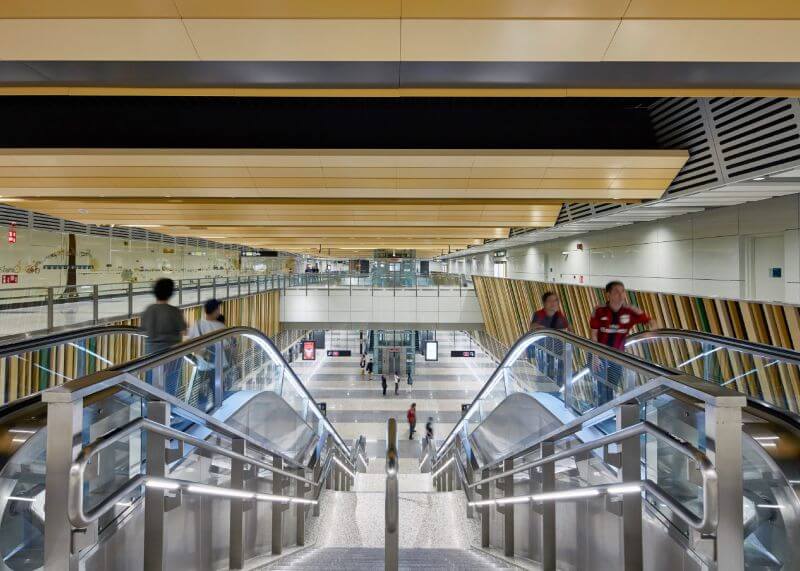
Singapore has one of the best public transport in the world — and for many visitors, the difference is immediately noticeable. Trains arrive on time, stations are clean and well-signposted, and travelling between cultural districts, attractions and neighbourhoods is remarkably seamless.
But Singapore’s transport success goes beyond efficient trains and buses. It is the result of decades of integrated urban planning, long-term infrastructure investment and careful coordination between housing, transport and land use.
If you are planning your trip, our Ultimate Guide to Public Transport in Singapore covers practical tips on using the MRT, buses, SimplyGo and tourist transport cards during your stay.
For travellers, this means exploring Singapore is not only easy — it is often efficient especially during peak hours and an affordable alternative to private car tours.
Efficient MRT Connectivity Across the Island
At the heart of Singapore’s public transport network is the MRT (Mass Rapid Transit) system. The rail network connects major districts including Chinatown, Marina Bay, Little India, Orchard Road and Changi Airport with reliable and frequent services throughout the day.
One of the biggest advantages for visitors is how intuitive the system feels. Stations are clearly labelled in English, alongside Singapore’s other national languages, transfers are straightforward, and most attractions are located within walking distance of an MRT stop.
Unlike many large cities where transport networks developed unevenly over time, Singapore’s MRT expansion was closely tied to national urban planning goals. Residential towns, commercial hubs and lifestyle districts were intentionally planned around transport accessibility from the beginning. As a result, travellers can comfortably explore multiple neighbourhoods in a single day without needing a car.
A Public Transport System Designed Around Urban Planning
Singapore’s transport efficiency is deeply connected to its broader urban planning philosophy.
Instead of approaching transport separately, Singapore integrates housing, commercial development, green spaces and transport infrastructure into a coordinated urban system. MRT stations are often embedded within shopping malls, linked to bus interchanges and connected through sheltered walkways and pedestrian networks.
This creates what urban planners call a “first-mile and last-mile” transport system — making it easy for commuters and visitors to continue their journey after leaving the train. For example, many public housing towns are designed around transport nodes and well-paved pedestrian networks, allowing residents to access schools, amenities, workplaces and parks without relying heavily on private vehicles.
This integrated planning approach is one reason Singapore consistently ranks highly for liveability and mobility.
Clean, Safe and Easy for Tourists to Navigate
For first-time visitors and repeat travellers alike, Singapore’s public transport system is exceptionally tourist-friendly.
MRT stations are air-conditioned, well-maintained and equipped with multilingual signage. Payment systems are simple, with travellers able to use foreign Visa or Mastercard bank cards directly on public transport through SimplyGo.
Safety is another major advantage. Visitors can comfortably use public transport late into the evening, including solo travellers and families with children. The combination of cleanliness, safety and predictability removes much of the stress associated with navigating an unfamiliar city.
Why Most Visitors Do Not Need a Car in Singapore
Unlike many destinations where travellers feel inclined to rent a vehicle, Singapore is one of the easiest cities in the world to explore without a car.
The MRT and public bus systems cover most parts of the island efficiently, while ride-hailing apps like Grab are widely available when needed.
In fact, owning a car in Singapore is considerably expensive due to government policies aimed at reducing congestion and encouraging public transport usage. Instead of prioritising highways and sprawling suburbs, Singapore invested heavily in public transport infrastructure and walkable neighbourhoods.
For tourists, this translates into:
- shorter travel times,
- lower transport costs,
- and a more relaxed sightseeing experience.
Many of Singapore’s most historically and culturally vibrant neighbourhoods — including Chinatown, Kampong Glam, Little India, Joo Chiat, the Civic District and Marina Bay are ideal for walking tours being located within central Singapore or city fringe.
Sustainability and the Future of Transport in Singapore
Singapore continues to invest heavily in sustainable mobility and future transport infrastructure. New MRT lines, electric buses, cycling routes and car-lite initiatives are part of the country’s long-term vision to reduce congestion and improve environmental sustainability.
The government’s “car-lite” strategy encourages greater reliance on public transport, walking and cycling instead of private vehicle ownership. Green corridors, park connectors and integrated transport hubs are increasingly shaping how residents and visitors move around the city. This forward-thinking approach helps Singapore remain not only efficient today, but adaptable for the future.
In Summary
Singapore’s public transport system is widely regarded as one of the world’s best because it was designed as part of a larger vision for how a city should function.
Efficient MRT connectivity, integrated urban planning, walkable neighbourhoods, safety and long-term sustainability all contribute to a transport experience that feels smooth and intuitive for both locals and visitors alike. For travellers, it means less time worrying about logistics — and more time enjoying Singapore’s culture, food, architecture and neighbourhoods.