
Since the 13th century, Singapore has been connected to the wider Malay world through the people, ports and trading routes of Southeast Asia. Kampong Glam later took shape through these regional connections and still carries many of their legacies today.
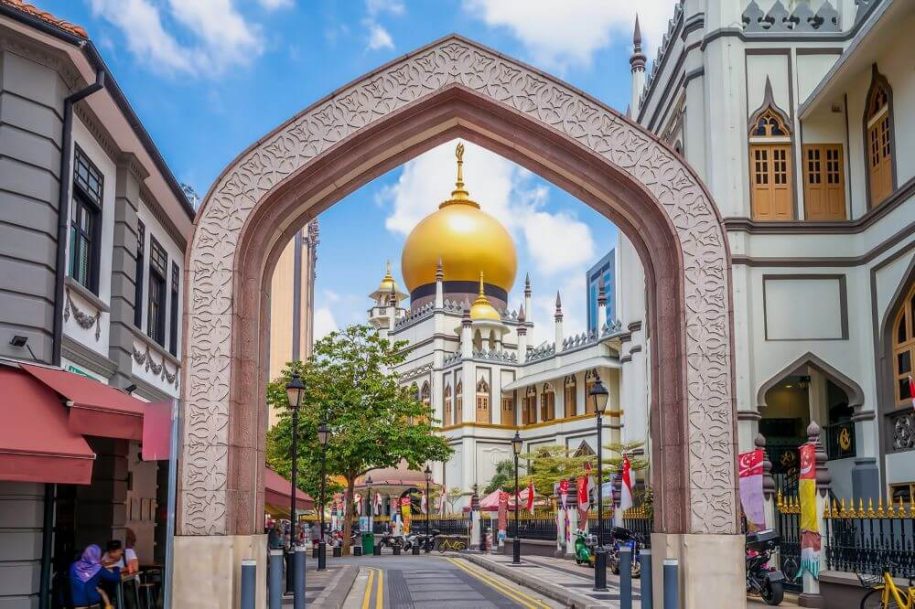
Today, Kampong Glam Singapore is easily recognisable by the golden dome of Sultan Mosque, the ornate shophouses of Haji Lane and the textile stores of Arab Street. Behind these familiar sights is a neighbourhood shaped by Malay royalty, traders, pilgrims and communities who arrived from across the region.
Their influence was evident in many aspects of life, from religion and commerce to the food people cooked and ate. Kampong Glam became a place where different cultures melded, adapted and left their mark on Singapore’s history.
Much of that history is still around today, woven through Kampong Glam’s labyrinth of side streets, although it is easy to walk past without noticing it.
Table of Contents
Why Is It Called Kampong Glam?
The neighbourhood is believed to take its name from the gelam tree, or Melaleuca cajuputi, which once grew abundantly in the area. According to Singapore’s National Library Board, the tree was useful to coastal communities. Its timber could be used for boats and firewood, while its bark had practical uses including sails and awnings.
The word kampong means village in Malay. This is why the neighbourhood is sometimes referred to as Kampong Gelam. Both spellings are used in Singapore today.
From Malay Royalty to Eclectic Neighbourhood

With a history stretching back more than 200 years, Kampong Glam was already a settlement when Stamford Raffles arrived in Singapore in 1819.
After the British established a trading post in Singapore that year, Kampong Glam became closely associated with Malay ruler Sultan Hussein Shah, whose agreement with the British helped pave the way for Singapore’s rapid growth as a trading port. His household was based in the area, around what is now Istana Kampong Gelam, home to the Malay Heritage Centre, close to Sultan Mosque.
Kampong Glam attracted people from across the region. Malays lived alongside Javanese, Bugis from Sulawesi, Arabs, Indians and other communities who made the neighbourhood their home. This is why describing Kampong Glam simply as Singapore’s historic “Malay quarter” only tells part of the story. It was a diverse neighbourhood connected to a much wider world.
Overtime, that diversity has taken on a more contemporary expression. Heritage businesses, independent boutiques, cafes, galleries, street art and nightlife now share the neighbourhood with longstanding religious and cultural landmarks, giving Kampong Glam the eclectic mix of old meets new that visitors encounter today.
A Neighbourhood Shaped Through Food
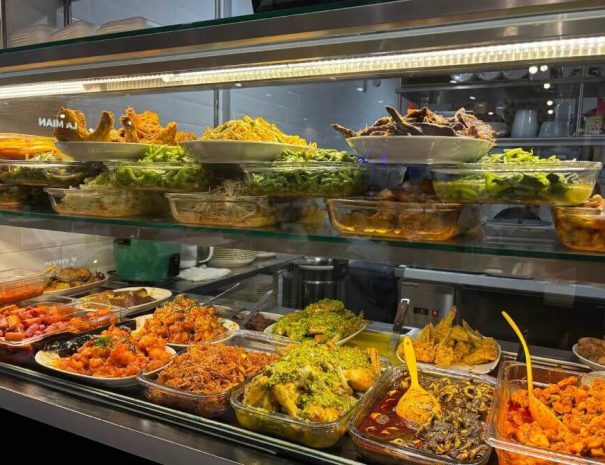
Food is another window into Singapore’s rich cultures, and in Kampong Glam, Malay flavours open up another side of the neighbourhood’s story.
Food historian Khir Johari, who grew up in the neighbourhood, describes old Kampong Gelam as a meeting place where people from different backgrounds exchanged ingredients, cooking traditions and ideas. Familiar dishes evolved in this environment too. He traces the development of Singapore-style mee siam, for example, to Javanese cooks in the area.
Different streets developed their own food traditions. Kandahar Street was once filled with stalls serving curries, breads and other dishes prepared by different Indian communities, while elsewhere in the neighbourhood Malay, Javanese and Indian Muslim food traditions flourished.
The food of Kampong Glam reflects the neighbourhood itself: shaped by people arriving from across the region, bringing their own flavours, traditions and ways of cooking with them.
Sultan Mosque at the Heart of Kampong Glam
Standing along Muscat Street, Sultan Mosque and its characteristic golden dome have become Kampong Glam’s most recognisable landmark and an important religious centre for Singapore’s Muslim community.
The first mosque on the site was built in the 1820s with the support of Sultan Hussein Shah. The present building dates from the early 20th century and was officially recognised as a National Monument in 1975. For generations, Sultan Mosque has played an important role in Muslim religious and community life in Singapore. Its history is also closely connected to the neighbourhood that developed around it.
A Historical Link to the Hajj
Long before air travel, pilgrims from across Southeast Asia would pass through Singapore on their journey to Mecca in Saudi Arabia. For some, Kampong Glam became an important stop along the way. Travellers stayed in the area, bought supplies and made arrangements before continuing their journey by sea.
Haji Lane, Arab Street and Bussorah Street Today
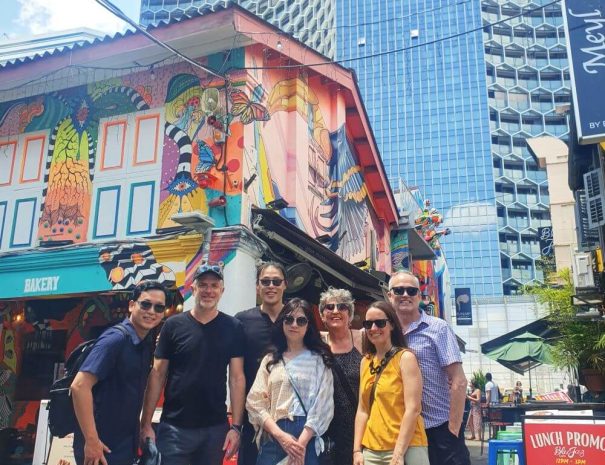
For many visitors, Haji Lane, once ranked by Time Out among the world’s coolest streets, needs little introduction. The photogenic stretch is known for its quirky murals, independent boutiques, cafes and bars.
Elsewhere in Kampong Glam, Arab Street takes on a different character as a textile and shopping hub, with fabric and carpet stores, traditional and contemporary perfumeries, and restaurants serving Malay and Middle Eastern food, including the likes of The Coconut Club and Ayasofya Turkish Restaurant. Bussorah Street offers yet another view of the neighbourhood, its rows of shophouses framing the approach to Sultan Mosque.
Each has developed its own identity: Haji Lane is energetic and contemporary, Arab Street draws travellers with a plethora of dining, textiles and perfumery shops, while Bussorah Street remains closely associated with the religious and historical heart of Kampong Glam. That contrast is part of what makes the neighbourhood interesting to explore.
Look Beyond the Shophouse Facades
Kampong Glam’s old shophouses are a good starting point for exploring the historic neighbourhood. Some are adorned with motifs and patterns, while others are more understated. At street level, attention naturally goes to shops, restaurants and murals, but there is often more to notice above them.
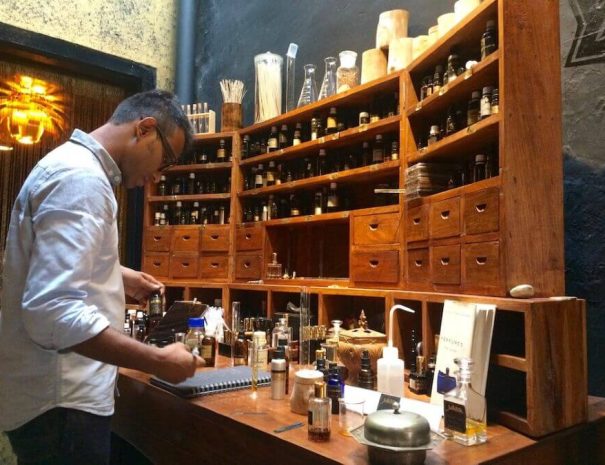
In 1989, Kampong Glam became a protected conservation area, helping to preserve much of the low-rise historic streetscape visitors see today. Within that setting, family businesses continue to carry the neighbourhood’s heritage forward in their own way. Sifr Aromatics draws on Kampong Glam’s long association with perfumery while giving the artisanal trade a fresh and modern take, while Rumah Makan Minang, established in 1954, hones its Minangkabau food traditions across generations.
It is this cultural shift that keeps Kampong Glam’s heritage relevant, appealing to Singaporeans as much as travellers discovering the neighbourhood for the first time.
Discover Another Side of Kampong Glam Through Art
For travellers who enjoy getting away from the busiest sights, art offers another way to explore Kampong Glam.
In the back lanes near Muscat Street, Gelam Gallery has turned walls and alleyways into an outdoor gallery filled with street art by local and international artists. A short walk away on Aliwal Street, Cuturi Gallery brings the experience indoors, presenting contemporary art within a conserved shophouse.
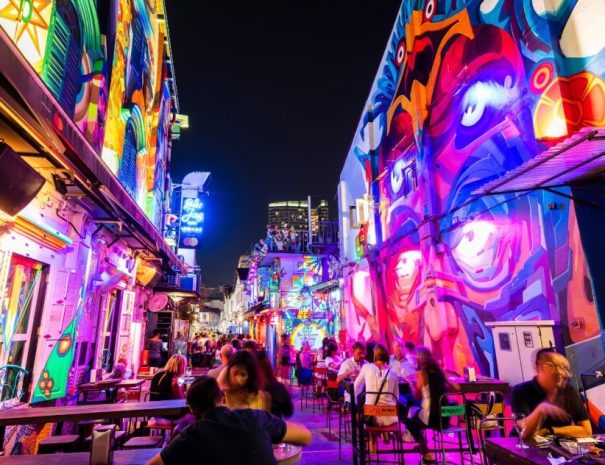
Stay for Kampong Glam After Dark
Come sundown, Kampong Glam takes on a different energy. Haji Lane becomes hip and edgy as bars and restaurants take centre stage, while live music has long been part of Kampong Glam’s after-dark appeal.
For a more relaxed evening, Bar Stories, established on Haji Lane in 2010, is one of the area’s longstanding cocktail bars. Nearby, Blu Jaz has been part of Kampong Glam’s live-music scene for years, with jazz, open-mic nights and performances.
Night time in Kampong Glam has a different atmosphere, with a dizzying choice of bars, restaurants and cafés for travellers with a little wanderlust and an appetite for spontaneous encounters.
Exploring Kampong Glam With a Local Guide
As local tour guides, we often find that travellers arrive knowing Haji Lane, but are surprised by the history and culture they experience in Kampong Glam once they venture into Arab Street, Bussorah Street and the surrounding lanes.
That is also why we often include a lunch stop in Kampong Glam on our private walking tours. Sharing a Malay meal gives travellers another way to understand the neighbourhood, through the flavours and food traditions of Singapore’s indigenous community.
Exploring Kampong Glam with a local guide helps bring the neighbourhood’s story to life in a way that’s easy to connect with. Instead of seeing Sultan Mosque, Arab Street or Haji Lane as separate stops, an experienced Singapore tour guide can connect the people, places and events behind them, showing how different communities have shaped the area over time and how their stories continue to overlap.
Kampong Glam can also be explored alongside other culturally rich neighbourhoods like Chinatown and Little India. Visiting these districts together gives travellers a fuller picture of Singapore’s multicultural roots, the communities that shaped the city, and how their histories have crossed and influenced one another over time.
Why Kampong Glam Is Worth Exploring
What makes Kampong Glam especially interesting is how much of Singapore’s wider story is concentrated within a walk-friendly neighbourhood. The former royal grounds recall the neighbourhood’s connections to Malay royalty; Sultan Mosque speaks to its longstanding Muslim community; while its shophouses, businesses and streets bear the influence of people who originated from the Malay Archipelago.
That makes it a neighbourhood worth slowing down for. The appeal is not only in what you see, but in understanding how these places fit together and what they tell us about Singapore.
Kampong Glam Singapore: Frequently Asked Questions
What is Kampong Glam famous for?
Kampong Glam is one of Singapore’s best-known historic cultural districts, known for Sultan Mosque, Haji Lane, Arab Street and Bussorah Street. Visitors also come for its conserved shophouses, Malay and Middle Eastern food, textiles, perfumeries, street art and nightlife.
Is Kampong Glam the same as Arab Street and Haji Lane?
No. Kampong Glam is the wider historic neighbourhood. Arab Street and Haji Lane are individual streets within the district, each with a different character. Bussorah Street and Sultan Mosque are also central to the area.
Is Kampong Glam worth visiting?
Yes. Kampong Glam combines history, Malay and Muslim heritage, food, art, shopping and nightlife within one neighbourhood. It also gives travellers a useful introduction to Singapore’s wider connections with the Malay world and the communities that helped shape the city.
Is it worth exploring Kampong Glam with a local guide?
A local guide can help you understand how places such as Sultan Mosque, Arab Street and Haji Lane fit into the wider story of Singapore. A private walking tour can also combine Kampong Glam with Chinatown and Little India for a broader understanding of Singapore’s multicultural roots and how its different communities have shaped the city.
About Culture Curious Singapore Tours
Culture Curious Singapore Tours designs private tours for travellers who want to understand Singapore beyond its major sights. Our guides combine the warmth of a local host with specialist knowledge of Singapore’s history, culture, food, architecture and transformation, creating engaging and conversational experiences shaped around travellers’ preferences.
Our small team of licensed Singapore tour guides brings professional experience across heritage, museums and education, urban planning, the arts and local food culture, allowing travellers to explore Kampong Glam from different perspectives through guided walks that can be culturally in-depth or light and conversational, depending on their interests.