
Last updated on April 10th, 2026 at 03:48 pm
Planning solo travel in Singapore? You’re choosing one of the safest and easiest cities to explore on your own. From late-night food spots to a transport system that is clean and efficient, Singapore removes much of the friction that solo travellers typically encounter.
In this guide, our team of Singapore tour guides share practical tips to help you explore confidently, eat well, and get a deeper sense of the city beyond the usual highlights.
This guide is especially useful for first-time visitors, solo female travellers, and those stopping over in Singapore.
1. Enjoy Singapore’s Safety—But Stay Street-Smart
Singapore is widely regarded as one of the safest cities in the world, making it especially comfortable for solo travellers—including those travelling alone for the first time. In the city centre, getting around on foot is straightforward, with well-marked crossings, pedestrian-friendly streets, and a strong sense of order (jaywalking is an offence, so it’s best to wait for the lights to change). Many key sights—including Merlion Park, Singapore Botanic Gardens, and the Singapore Flyer—are easily accessible from central districts.
That said, basic precautions still apply—keep valuables close in crowded areas such as Chinatown and Sentosa, stay hydrated in the heat, and remain aware of your surroundings. Singapore’s tropical climate means plenty of sunshine, often punctuated by short, sudden downpours, so carrying a small umbrella can be super convenient.
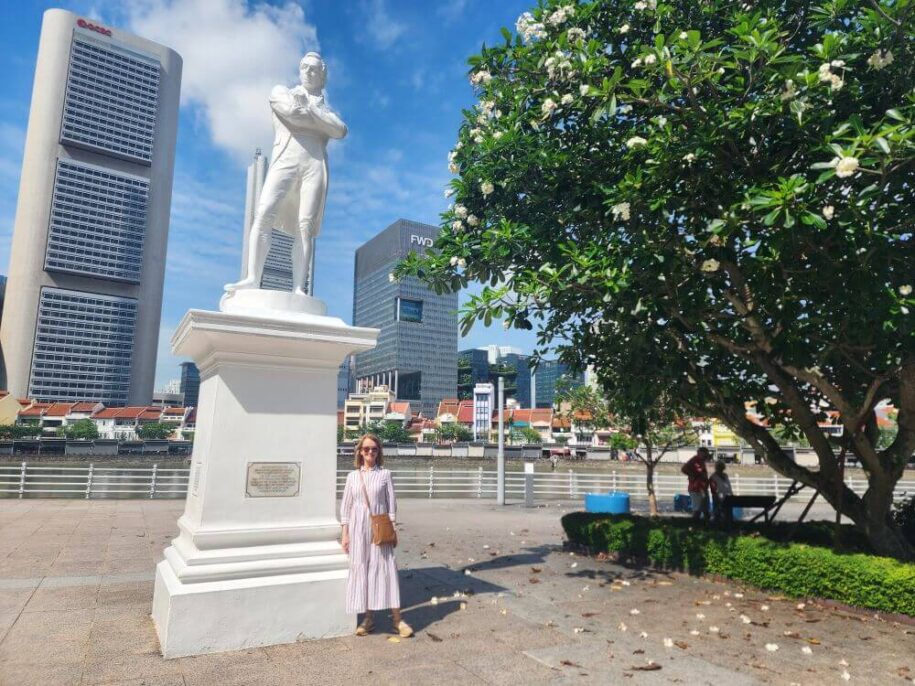
For a relaxed evening, head to Clarke Quay along the Singapore River, where former godowns have been repurposed into cafés and restaurants that spill out into alfresco dining spots after dark. Nearby, Marina Bay Sands hosts the nightly Spectra light show—an easy way to experience the city after sunset.
Local Guide Tip:
Download ride-hailing apps like Grab or Gojek for convenient late-night transport.
2. Use the MRT for Easy, Affordable Transport
Singapore’s Mass Rapid Transit (MRT) system is one of the most efficient ways to get around the city. If you’re visiting for the first time, our Public Transport Guide explains how to navigate the system with ease.
Stations are clean, clearly signposted, and connected to most major attractions. For solo travellers, it offers independence without complexity—no need to rely on taxis.
Local Guide Tip:
Download the SMRT network map to your phone—it’s a simple way to get a quick visual overview of the system while on the move. Wayfinding within MRT stations is intuitive, with colour-coded lines and clearly marked exits (A, B, C) that make navigation straightforward.
3. Join a Walking Tour to Understand the City
If you’re travelling alone, a guided walking tour is one of the fastest ways to get your bearings in Singapore. Beyond logistics, it gives you a clearer interpretation of the city—how neighbourhoods took shape, how communities interact, and what’s easy to miss when exploring on your own.
Historical neighbourhoods like Chinatown, Kampong Glam, and Little India give tourists a good sense of how Singapore’s multicultural identity is expressed on the ground—from former waterfront temples and mosques to spiced tea purveyors and streets that still carry traces of the past.
For travellers seeking a more personalised experience, our private walking tours
in Singapore offer the flexibility to explore at your own pace, with deeper insights tailored to your interests. Whatsmore, pick up is included in central Singapore for your convenience. Otherwise your local guide can meet you at a centrally located MRT station.
Local Guide Tip:
If you’re short on time, schedule your walking tour early in your trip—it helps you get your bearings quickly and makes the rest of your stay easier to plan. It also serves as a solid jumping off point, with your expert tour guide sharing practical tips and insider recommendations to help you navigate Singapore with confidence.
4. Eat Freely at Hawker Centres
Solo dining in Singapore—especially at a hawker centre—feels entirely natural. Tables turn quickly, seats are shared without fuss, and eating alone rarely draws a second glance. If you’re after a culturally meaningful way to see the city, a Food Tour combining tastings and historical insights can be a fun activity for solo travelers too.
If you’d rather slow things down, cafés offer a different rhythm. Settle in with a coffee and light bite at Terra Cafe on Pagoda Street, Chinatown or % Arabica at Kampong Glam — places to watch street life unfold or spend a quiet hour with a book.
Local Guide Tip:
If you prefer to skip the crowds, start your day early—around 8am, when most hawker centres are already open. Popular breakfast options include kaya toast, roti prata, and fishball noodles. For a deeper dive, explore our Singapore Hawker Guide to learn how to navigate hawker centres like a local.
5. Explore Singapore on Foot or by Bicycle
Singapore is easy to navigate on foot, with well-connected pavements, sheltered walkways, and clear signage linking one district to the next. Much of this ease is by design. The city’s compact layout and transport infrastructure have been carefully planned to support what planners often describe as a car-lite city—where walking, cycling, and public transport are prioritised.
This emphasis on connectivity reflects Singapore’s broader urban planning approach—where transport, greenery, and land use are integrated rather than treated separately.
Across the island, the Park Connector Network—developed by the National Parks Board—links green spaces, residential areas, and waterfronts through continuous cycling and walking paths. In the city centre, these routes connect seamlessly with promenades and pedestrian corridors shaped by the URA Center’s long-term planning vision.
Local Guide Tip:
Try the Bay East Garden at sunset, or follow the Singapore River between Robertson Quay and Clarke Quay—routes that show how greenery, waterfronts, and the skyline are woven into the city’s beautiful cityscape. For route details and maps, refer to the National Parks Board’s guide to the Marina Bay and Park Connector Network.
6. Visit Museums to Understand Singapore’s Arts and Culture

Singapore’s museums are conveniently located in the city and offer an immersive environment to learn about Singapore’s history, art and culture—useful if you’re trying to make sense of how its different communities, policies, and spaces fit together.
Located within the Civic District, solo travellers will find it extremely easy to explore several in a single visit. Landmarks like the National Museum of Singapore and Asian Civilisations Museum are especially suited for self-paced exploration—and provide a comfortable space with cafes and museum shops for you to spend time at after your visit.
As you move between them, it’s worth keeping an eye out for public art in the area—from sculptures like Cendana by Kumari Nahappan (often referred to as the “chilli padi”) to works such as Singapore, 24 Hours at the Asian Civilisations Museum, which offers an unexpected, multi-perspective view of the city across a single day.
Local Guide Tip:
Plan your museum visits in the afternoon, when the heat and sudden rain showers are most likely. The Civic District is relatively compact, so you can comfortably explore the museums and nearby landmarks on foot.
7. Stay in Well-Connected Neighbourhoods
Where you stay influences how naturally your day unfolds—being close to an MRT station or within a walkable neighbourhood means you spend less time navigating and more time exploring the city.
Areas like Bugis, Chinatown, Orchard, Little India and Civic District are central and well-connected, making it easy to move between neighbourhoods with minimal effort and ease.
Local Guide Tip:
Choose Clarke Quay or Arab Street for nightlife, or Tiong Bahru and the Civic District for a quieter stay. For a more detailed breakdown, see our Guide to the Best Hotels in Singapore, based on feedback from our travellers.
8. Talk to Locals for Unexpected Insights
Singaporeans may come across as reserved at first, but most are approachable and willing to help—especially when it comes to food recommendations. Simple questions often lead to surprisingly warm interactions, whether you’re at a hawker centre, café, or on public transport.
English is commonly spoken, making it easy for you to strike a conversation with Singaporeans. You might also notice locals slipping into Singlish—a colloquial mix of English, Malay, Chinese dialects, and Tamil—which reflects the city’s multicultural roots. Phrases like “can” (yes/okay) or “shiok” (something especially satisfying) are commonly used in everyday conversation.You don’t need to use it yourself, but recognising a few expressions can offer a small window into how locals communicate.
Local Guide Tip:
If someone replies with a quick “can” or “yah” or points you in a direction without much explanation, that’s often just the local way—brief, but usually accurate.
Is Singapore good for solo travel?
Yes. Singapore is one of the safest and easiest destinations in Asia for solo travellers, with efficient transport, clear infrastructure, and a strong sense of security. Singapore is also one of the best cities for solo travellers—safe, easy to navigate, and rich in cultural experiences.
With the right balance of planning and spontaneity, you’ll experience not just the sights, but the stories behind them.
If you’d like to go beyond surface-level exploration, a private walking tour offers a more grounded way to understand how the city actually works—with an expert local guide.
Frequently Asked Questions About Solo Travel in Singapore
Is Singapore safe for solo female travellers?
Yes, Singapore is widely considered one of the safest cities in the world for solo female travellers. Crime rates are low, public spaces are well-lit, and public transport is reliable even at night. Public transport including MRT usually operate till 11 pm or so. Check with individual MRT stations for the most accurate train departure timings.
How many days do you need for solo travel in Singapore?
Most solo travellers find that 3 to 4 days is enough to explore Singapore’s key neighbourhoods, cultural sites, and food scene at a comfortable pace with enough flexibility to account for the city’s heat and sudden tropical showers.
Is Singapore expensive for solo travellers?
Depending on travel season, Singapore can be a little pricey, but solo travellers can manage costs by relying on public transport and eating at casual eateries, cafés, and hawker centres, where meals are both affordable and varied. Food courts in shopping malls offer a similar range of local dishes in a more comfortable, air-conditioned setting—especially useful during the midday heat.
What are the best things to do alone in Singapore?
Some of the best things to do alone in Singapore include exploring neighbourhoods like Chinatown, Kampong Glam, and Little India, visiting museums, enjoying hawker food, and joining a walking tour for deeper insights.
Is Singapore good for solo travel?
Yes, Singapore is one of the best destinations in Asia for solo travel. It is safe, easy to navigate, and well-connected by public transport, making it ideal for independent travellers exploring on their own.