
Last updated on July 7th, 2026 at 03:44 pm
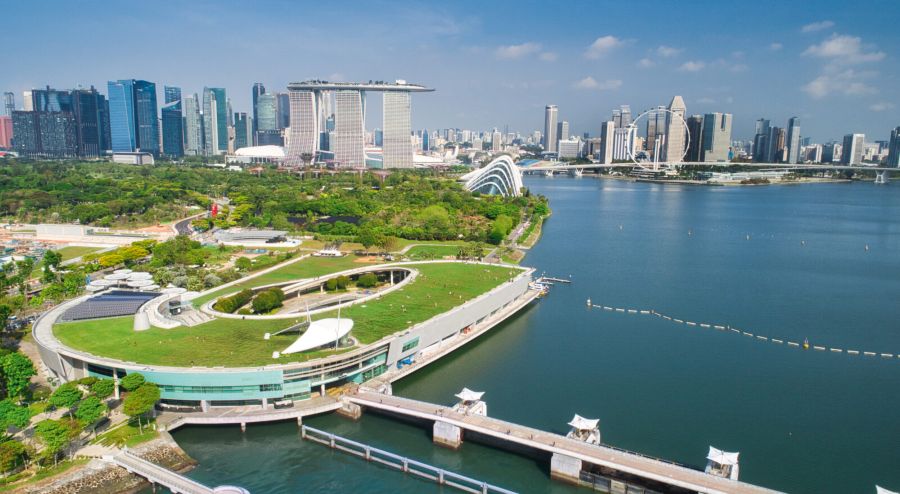
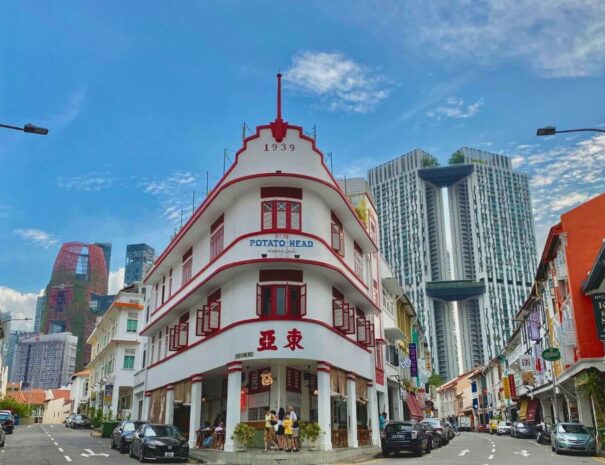
Singapore makes an immediate impression as a country of striking contrasts, thoughtful city planning and distinctive urban design. This coexistence of old and new architecture is especially visible in downtown Singapore, where historic shophouses, civic landmarks and places of worship sit within view of glass towers and architectural marvels such as Marina Bay Sands and Marina Barrage.
Small in size but expansive in experience, Singapore stands out as a global city where modern ambition and cultural memory sit side by side, shaped by immigrant histories, colonial encounters, long-term urban planning and constant reinvention, while food traditions, festivals, languages and neighbourhood stories continue to give the country its distinctive sense of place.
The idea of Singapore as a global city is not new. In 1972, S. Rajaratnam, one of Singapore’s pioneer leaders, described Singapore’s future as one that would depend on being connected to the wider world — through trade, aviation, finance, communications and international networks. More than five decades later, that vision still helps explain the visitor experience in Singapore today.
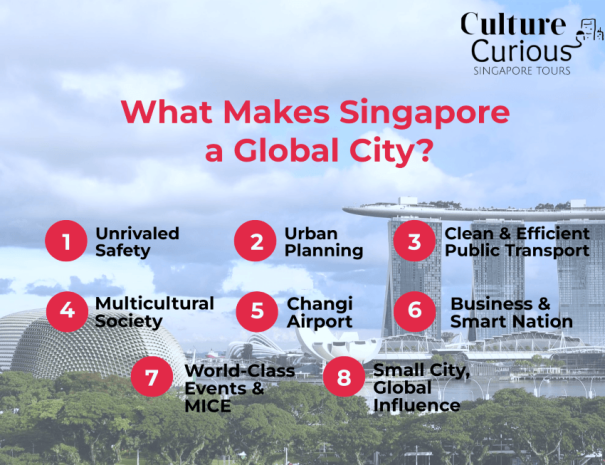
Singapore’s global-city status reflects decades of thoughtful planning and the way complementary strengths reinforce one another. Safety encourages people to explore, public transport links neighbourhoods, a world-class airport connects Singapore to the world, multicultural communities preserve living traditions, and continued investment in innovation ensures the city keeps evolving. Collectively, these qualities help explain why Singapore is a global city with a reputation that extends far beyond its size.
Whether you are visiting for leisure, business or a short stopover, understanding the ideas behind Singapore’s growth offers a deeper appreciation of how a small island nation continues to shape an influence far beyond its size – a journey explored in our Urban Planning & Public Housing Tour, where these ideas come to life through the neighbourhoods, policies and stories that have shaped modern Singapore.
Table of Contents
At a Glance: The 8 Pillars That Make Singapore a Global City
Singapore’s global-city status reflects decades of thoughtful planning and the way safety, urban planning, connectivity, multiculturalism, innovation and global partnerships reinforce one another.
1. Singapore Is Among the Safest Places in the World
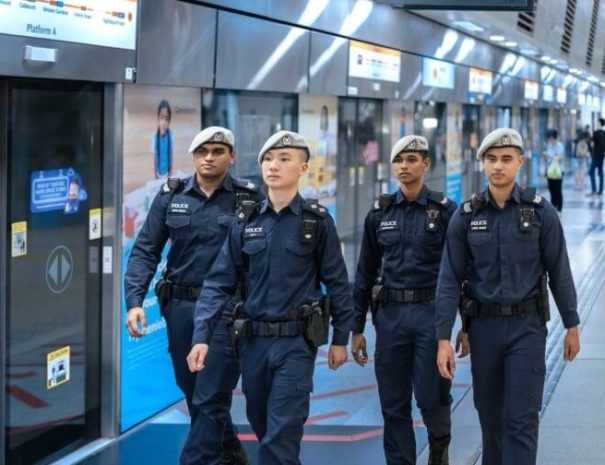
Singapore’s reputation as a global city begins with something visitors notice almost immediately: safety.
In a 2026 feature on the world’s safest countries, BBC Travel highlighted Singapore’s low crime rates, strong rule of law and high levels of public trust as key reasons it consistently ranks among the safest places in the world. This is supported by the 2026 Global Peace Index, where Singapore ranked among the world’s most peaceful countries and was reported as the most peaceful country in Asia.
For travellers, this matters in practical ways. It means you can stroll along the waterfront at Marina Bay after dark, explore the alleyways of Joo Chiat, wander through the bustling lanes of Chinatown, or enjoy a dazzling evening on Sentosa Island with greater peace of mind. Whether returning to your hotel by MRT, bus or taxi, visitors often remark on how safe, clean and comfortable Singapore feels at all hours.
This sense of safety shapes the visitor experience in a deeper way. It allows families, solo travellers, business visitors and transit passengers to move through the city with confidence. Instead of planning around risk, travellers can focus on neighbourhoods, food, architecture, public spaces and cultural encounters. In that sense, safety is not just a statistic. It is part of what makes Singapore feel accessible, well-managed and easy to explore.
Culture Curious Observation: A question we are frequently asked on tour is whether there are any neighbourhoods visitors should avoid. By and large, Singapore is a safe destination for locals and travellers alike. Using public transport and heading out at night are both a normal part of life here, including for many local women travelling on their own. As with any destination, it is still sensible to exercise normal precautions, such as being aware of your surroundings and avoiding poorly lit or unfamiliar areas late at night. For most visitors, however, Singapore’s neighbourhoods are welcoming and easy to explore. Whether you’re travelling solo or with family, Singapore is a welcoming destination for visitors of all ages and travel styles.
2. World-Class Urban Planning
Singapore’s transformation from a developing nation into one of the world’s most liveable cities did not happen by chance. It is the result of decades of long-term planning and deliberate decisions about how land should be used.
Housing, transport, commercial districts, parks and old neighbourhoods have been planned as part of a wider urban system rather than as isolated developments. Public housing estates are designed with schools, markets, healthcare facilities, parks and transport connections nearby, while green spaces are woven throughout the city.
The emphasis on greenery is another defining feature that often surprises visitors to Singapore. Despite being one of the world’s most densely populated countries, Singapore has gained international recognition for integrating nature into its urban landscape through long-term planning. Singapore’s founding Prime Minister, Lee Kuan Yew, famously said, “I always believed that a blighted urban jungle of concrete destroys the human spirit. We need the greenery of nature to lift up our spirits.” This philosophy helped shape the nation’s vision and continues to influence Singapore’s identity as a “City in Nature.”
That vision is evident across the island today. Environmentalist David Bellamy once remarked that Singapore has more tree species than the contiguous United States, highlighting the city’s rich biodiversity despite its small size. From tree-lined streets and park connector networks to protected nature reserves, rooftop gardens and thoughtfully landscaped public spaces, greenery is not an afterthought but an integral part of how Singapore has been planned, experienced and continues to evolve.
Visitors often notice how easy Singapore is to navigate, but that convenience is the product of deliberate planning rather than coincidence.
This planning is visible even on a short visit. A traveller can travel from a public housing estate to a hawker centre, from a heritage district to a business waterfront, or from a park connector to an MRT station without feeling that these parts of the city are disconnected. Singapore’s urban planning is not only something studied by policymakers; it is something visitors experience through the ease of their day-to-day activities in the city.
Take Punggol, for example, where housing, schools, waterfront spaces, cycling paths and public transport have been planned as an integrated neighbourhood. In the city centre, Marina Bay shows how former reclaimed land has been transformed into a district that combines business, public spaces, cultural attractions and green infrastructure. These places illustrate how long-term planning continues to shape Singapore’s growth while balancing liveability, economic development and environmental sustainability.
3. Public Transport Makes Exploring Singapore Easy
Singapore’s public transport network is regularly recognised for its reliability, cleanliness and ease of use. But beyond convenience, it reflects the country’s long-term approach to urban planning and creating a highly connected city.
The MRT and public bus systems connect major attractions, neighbourhoods, hotels and business districts across the island. Combined with contactless payment options and clear signage, visitors can travel confidently without needing to rent a car. Continued investment in rail reliability, bus connectivity and transport upgrades has helped make public transport a practical daily choice for residents while giving visitors a convenient way to see the city.
Singapore also continues to pursue a long-term vision of becoming a more car-lite city. Rather than encouraging greater car ownership, planners have focused on creating a people-oriented transport system where walking, cycling and public transport become preferred ways to travel. This integrated approach supports liveability, reduces congestion and allows valuable land to be used for housing, parks and public spaces instead of simply accommodating more roads.
For visitors, the benefits are immediately noticeable. It is possible to experience very different parts of Singapore within a single day, whether travelling between Marina Bay, Chinatown, Kampong Glam, Little India or neighbourhoods beyond the city centre. The ease of moving around is one of the reasons Singapore feels accessible, efficient and well connected.
Culture Curious Observation: Many of our guests are surprised by how quickly they become comfortable using Singapore’s public transport. Even visitors who rarely take trains or buses at home often find themselves confidently navigating the MRT after just a few journeys. For many, riding the MRT is more than simply travelling between attractions — it offers a glimpse into local life in Singapore as commuters from all walks of life share the same efficient public transport system.
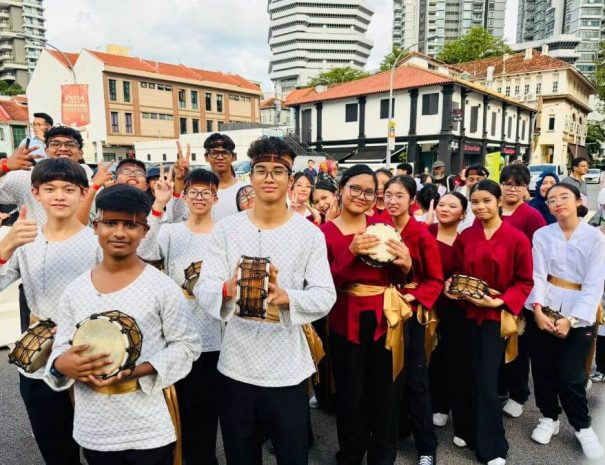
4. A Multicultural Society Built on Racial Harmony
In 2026, Singapore was named the World’s Best Cultural Destination in Tripadvisor’s Travellers’ Choice Awards: Best of the Best, recognising the country’s rich blend of cultures, heritage and living traditions.
While Singapore is perhaps best known for its modern skyline and global outlook, many locals would tell you that it is our shared cultures that truly define our uniquely Singaporean identity. Beyond the facades of heritage neighbourhoods, historic landmarks and colonial-era places of worship lie enduring food traditions, customs and living heritage that give the Little Red Dot its distinctive character. For the culturally curious, they offer an opportunity to experience traditions that continue to shape daily life in Singapore.
One of the best examples can be found in Chinatown. Within just a few minutes’ walk of one another stand the Buddha Tooth Relic Temple, Sri Mariamman Temple and Jamae Mosque. Rather than existing in isolation, these places of worship reflect centuries of migration, trade and cultural exchange, illustrating how different communities have lived alongside one another while contributing to Singapore’s shared identity.
Singapore’s multicultural society developed from its origins as part of the Malay world, through the British colonial era, and later as an independent nation. Today, Chinese, Malay, Indian, Eurasian and Peranakan influences continue to shape the country’s architecture, festivals, languages and food traditions.
What makes Singapore distinctive, however, is not simply the diversity of its population. Social harmony has been consciously nurtured over many decades and continues to be strengthened through trust, shared spaces and regular interaction between communities. It is one of the reasons visitors often remark on how seamlessly different cultures coexist within a single city.
Our Singapore Cultural Tour explores Chinatown, Kampong Glam and Little India and other culturally diverse districts with a local Singapore guide, connecting communities, migration, faith and food traditions into a deeper understanding of Singapore’s multicultural landscape.
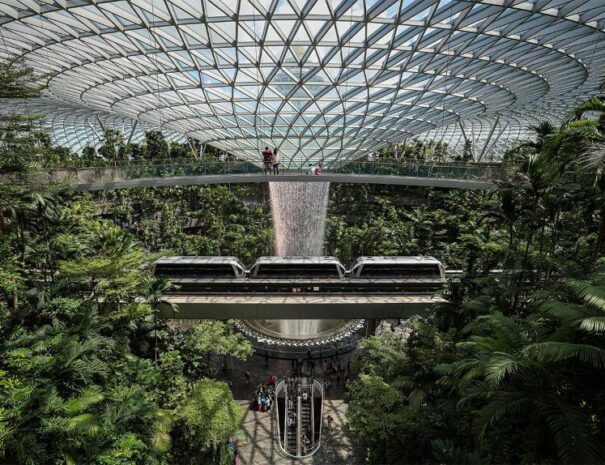
5. Singapore Changi Airport Connects the City to the World
A global city depends on excellent connectivity to the world and Singapore Changi Airport plays an instrumental role in positioning Singapore as a world-class aviation hub. For decades, Changi has consistently ranked among the world’s leading airports, connecting Singapore with hundreds of destinations across Asia, Europe, Australia, the Americas and the Middle East.
Singapore’s role as a global hub is especially evident in its airport connectivity, business networks and events calendar. For travellers on a stopover, efficient airport procedures, good transport links, Singapore’s efficient transport system and the close proximity between major attractions make it possible to experience a meaningful introduction to the city, even during a relatively short transit, which makes a layover city tour a great and practical idea.
In fact, Singapore is already looking beyond today’s aviation needs. Scheduled to open in the mid-2030s, Changi Airport Terminal 5 will significantly expand the airport’s capacity while serving as the centrepiece of the wider Changi East development. Designed with advanced automation, sustainable features and passenger-focused spaces, the next-generation terminal reflects Singapore’s long-term commitment to remaining one of the world’s leading aviation hubs. As designer Thomas Heatherwick describes it, the vision is to create “a place that you’d want to travel to, rather than just travel through”- one that welcomes both international travellers and the local community.
Culture Curious Observation: One of the first impressions many visitors share is that Changi Airport doesn’t feel like an airport. Instead, it feels more like a lifestyle destination, with gardens, shopping, restaurants and family-friendly attractions all under one roof. That’s one reason many Singapore residents also visit Changi Airport to dine, relax or spend time with family and friends, even without catching a flight.
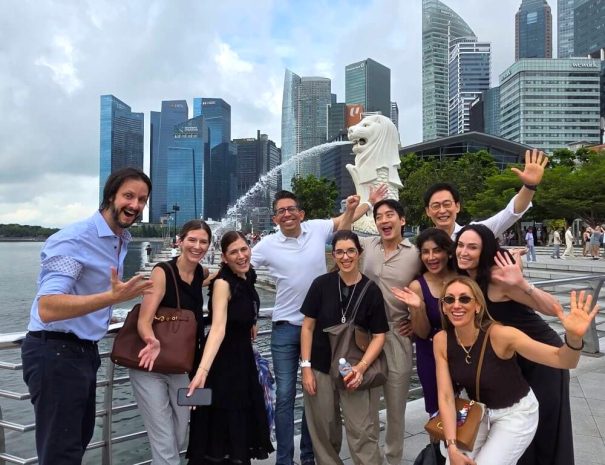
6. A Global Hub for Business and Innovation
Singapore’s global influence extends well beyond tourism. Many visitors first notice this in the city skyline: the financial towers of Raffles Place, the waterfront offices around Marina Bay and the research clusters and industrial parks located beyond the city center.
But Singapore is not only a place where global companies establish regional headquarters. Increasingly, it is where businesses develop new technologies, test ideas and create products for Asian and international markets.
According to a 2026 Straits Times feature produced with Singapore’s Economic Development Board, companies have committed more than S$14 billion in research and innovation investments in Singapore over the past five years. Singapore’s Research, Innovation and Enterprise 2030 plan also commits S$37 billion to areas including health, advanced manufacturing, sustainability, urban solutions and the digital economy.
What does this mean in practice? It means Singapore is being used as a testbed for the future. Global companies are working on cleaner transport, smarter urban systems, sustainable materials and technologies that improve daily life. Together with Singapore’s Smart Nation vision, these innovations are reflected in many aspects of the visitor experience—from seamless digital services and efficient public transport to smart buildings and a city that continues to evolve through technology. In fact, our travellers often comment how widely card and cashless payments are accepted across Singapore, including the ease of contactless fare payment on public transport.
For organisations, universities and professional groups wanting to understand Singapore as a global city, our Corporate Tours explore topics such as urban planning, public housing, sustainability, economic development and multiculturalism through guided visits and discussions tailored to your objectives.
7. World-Class Events and Tourism Experiences Throughout the Year
Singapore’s global-city status is reinforced by its ability to turn events into wider visitor experiences.
The Formula 1 Singapore Grand Prix, major concerts, food festivals, exhibitions, sporting events and business conventions do more than fill the calendar. They demonstrate how Singapore’s airport connectivity, transport network, safety, venues and hospitality sector work together to support large-scale tourism.
According to the Singapore Tourism Board, Singapore continues to strengthen its position as one of the world’s leading destinations for meetings, incentives, conventions and exhibitions (MICE). Its recent calendar has brought together global leaders across fields including artificial intelligence, clean energy, life sciences and urban development, alongside large-scale corporate events attracting thousands of delegates. These gatherings reinforce Singapore’s role as a trusted platform for international collaboration, innovation and business exchange — another reason why the city continues to stand out as a global hub.
This is especially significant because Singapore has few natural advantages typically associated with major tourism destinations. As a small island nation with limited land and natural resources, it has built its reputation through long-term planning, excellent connectivity and a visitor experience that extends well beyond the airport. Attractions, neighbourhoods, events, transport and hospitality complement one another, creating a destination where every part of the journey feels intentionally connected.
You can see this approach in places such as The Kallang, where sport, entertainment, dining, retail and community programming come together to create a year-round destination rather than a venue used only on event days. Changi Airport offers another example, using thoughtful design and technology to make travel feel smoother, more engaging and less stressful.
This is why events matter to Singapore’s global-city status. They are part of a robust tourism ecosystem where transport, attractions, hospitality, technology, culture and events programming work together to create experiences that encourage visitors to stay longer, explore more and return again.
Culture Curious Observation: First-time visitors can look forward to a wide array of things to see and do within the city centre alone. Year-round events, festivals, concerts and exhibitions add to the buzz, but even outside the major event calendar there are countless opportunities to explore Singapore’s heritage, cultures and food traditions in its neighbourhoods. Because Singapore is relatively small and easy to get around by both public transport and private vehicle, it’s also easy to venture beyond the city centre, even on a brief visit.
8. A Small Nation with Global Influence
Singapore is often called the Little Red Dot, yet its influence extends far beyond its physical size.
Countries around the world study Singapore’s approaches to urban planning, public housing, transport, education, sustainability and economic development. While every nation has its own circumstances, Singapore’s journey from a young independent nation to a respected global city continues to attract international interest.
For visitors, there is much more to discover than unmissable landmarks. Understanding the thinking behind Singapore’s urban transformation and its post-independence journey helps explain how a small island nation evolved into a green oasis for business, innovation and liveability. For both leisure and business travellers alike, this deeper perspective offers a greater appreciation of the ideas behind Singapore’s Smart Nation vision and the foundations that continue to support the country’s growth despite its diminutive size.
Ultimately, Singapore’s influence is measured not simply by its skyline or economic success, but by how effectively it brings together safety, connectivity, multiculturalism, innovation and thoughtful planning into a city whose global influence far exceeds its physical size.
Culture Curious Observation: One fact that often surprises visitors is that around 90% of Singapore’s food is imported. There’s a good chance that some of the fruit, dairy products, wine or other ingredients you see on supermarket shelves have come from your own part of the world, whether that’s Southeast Asia, Australia, Europe or the Americas. Rather than being a weakness, Singapore has built a highly diversified food import network, sourcing from many countries instead of relying heavily on just a few. To us, it is a practical example of how this small island nation remains deeply interconnected with the world through international trade, logistics and long-standing global partnerships—another reminder that Singapore’s global influence extends far beyond its physical size.
Experience Singapore Beyond the Landmarks
Understanding what makes Singapore a global city is even more rewarding when you experience it with a Singapore tour guide who brings together local knowledge and insights into the city’s history, cultures, urban transformation and day-to-day life.
At Culture Curious Singapore Tours, our private Singapore City Tour connects the landmarks with the stories behind them, helping you understand how Singapore evolved from a young nation into one of the world’s leading global cities. Whether you’re visiting for the first time or returning to discover a different side of Singapore, it offers a deeper appreciation of the people, ideas and planning that continue to shape the Little Red Dot today.